Showing posts with label black women breastfeeding. Show all posts

Tuesday, July 3, 2012

Milk Samples Needed for Breast Cancer Research Study

African American moms are needed for a breastmilk study. Can you help?


As I've written before, I have the privelege of working with Professor Kathleen Arcaro at the University of Massachusetts, Amherst, on her groundbreaking breast cancer/breastmilk research.

Kathleen analyses breastmilk to study DNA changes in breast cells, which are naturally present in breastmilk, and their relationship to breast cancer. It's very gratifying work because a better understanding of these patterns may one day lead to new early detection, prevention and treatment strategies for breast cancer. Here's a sampling of some of the recent press coverage about this research.

Our current goal is to recruit African-American mothers to donate milk samples. Why African-American moms? Because Kathleen wants to ensure that her findings apply to all women, and to do that she needs a diverse sample of mothers participating. Having African-American moms well represented in this research is of particular interest because we have different patterns of breast cancer than women of other races. You may know that black women are more likely to get triple negative breast cancer, which is more aggressive and more likely to reocur, spread beyond the breast and result in death.
One of my main duties is helping Kathleen recruit moms to participate in her studies. The response to her work has been incredible, but we still need more black moms to donate breast milk! So, the UMass Breastmilk Lab is currently seeking:
•African American mothers who are nursing

•Living anywhere in the U.S.

•Willing to donate a *fresh* breastmilk sample (shipped via overnight mail at the lab's expense)

•Willing to fill out a consent form and questionnaire

Participants will receive $25 in thanks - and the knowledge that they are advancing our understanding of breast cancer! I hope that you can donate, or help us find moms willing to donate milk for this important research.


To participate, or for more information, you can email Beth, or call Beth or Eva at (413) 545-0813. More information is also available at the UMass Breastmilk Lab website. You can also like us on Facebook where we're keeping you updated on the latest in breastmilk research and Kathleen's work!
We need help spreading the word about this study. Contact me if you'd like me to write a guest post, and link, share on Facebook, Pin, and Tweet to your heart's content!

And if you're African-American (nursing or not), PLEASE consider signing up for the Love/Avon Army of Women, who are funding this important research. Please select "Breast milk study" when asked how you heard about the Army of Women.


Never want to miss an update of the Blacktating Blog? Subscribe here. Follow me on Twitter- http://www.twitter.com/blacktating

Thursday, April 14, 2011

Guest Post: Our Unassailable Bond

I'm pleased to present a guest post today from K. Emily Bond, Writer, Editor, Researcher and Blogger Extraordinaire! 

Through blood and tears, breastfeeding fortified our unassailable bond

Once upon a time, pre-baby when my life was one big ball of crime writing ambition, I had a literary agent who told me, “I was not someone who had to have a kid, you know what I mean?”

I can’t resist the impulse to fact-check. The preceding was an estimation of what she said to me in my heavily pregnant state—and I don’t need to remind you how reliable our memories are 40 weeks into gestation.

Basically she was conveying that “maternal” was not a state that came naturally to her. Breastfeeding on the other hand, the most primal of maternal acts, caught her by surprise. This, I remember her saying pretty accurately: “The thing I miss most is nursing.”

I didn’t get it at the time. Her kid was a teenager whose best friend’s dad was a famous rock star. Clearly, a lot had transpired since she weaned: first steps, first words…first VIP passes to the MTV Music Video Awards. How could nursing be the thing she reflected on or even missed the most?

Now, six months after my son and I have weaned, I’m starting to get it.

In the beginning…

For me, nursing was an exceedingly difficult physical challenge. I had a C-section, for starters, and at one point during the birth had been put on antibiotics. As such, my body and son’s mouth became a Petri dish for sharing candida: the dreaded oral thrush. Ouch.

For weeks, I endured bleeding, cracked nipples, piercing razor-like pain that shot through my breasts like daggers each and every time my son latched on. Taking a shower was an event I dreaded because I knew at some point water would have to come in contact with my tender nipples. And, truth be told, every time my little bundle of discomfort—sorry, joy—wanted to nurse, I’d cringe: “Oh, no…not again!”

Those initial months…well, they sucked. And, oy vey, could that boy suck—with the ferocity of a Hoover, or a character out of Twilight.

Come hell or high water, though—or in this case, cracked nipples or bleeding—I made a commitment to my son and to myself to keep on nursing. And we did, boobs in tact.

What saved our nursing relationship in the end was La Leche League International, Nystatin, dietary changes (more leafy greens and yogurt; less refined sugars and carbohydrates) and these:

Yes, I spent much of my babymoon looking like a 50s pinup girl, but breast shells were essential in helping my body heal so that I could start enjoying nursing.

A nursing revolution…

Nip slips never bothered me. It didn’t matter where I was or how shocking it might have looked in an Ikea aisle, house of worship, pancake house or shopping mall. If it was time to nurse, the boobs came out. I got the occasional comment, sure. But nursing was too precious of a bond to be cut short by a guy who said stupid things like, “You need to give that baby a biscuit,” with his pregnant wife in tow.

My attitude was, “if you don’t like it… stop looking.” Perv.

In retrospect, I did perhaps take some perverse pleasure in shocking dudes like that. I felt like a revolutionary demonstrating to the world how natural it is to integrate nursing into your daily life. It was a bit, “look at me – I can nurse and shop for groceries at the same time!” but it was true…with a good baby carrier, anything is possible.

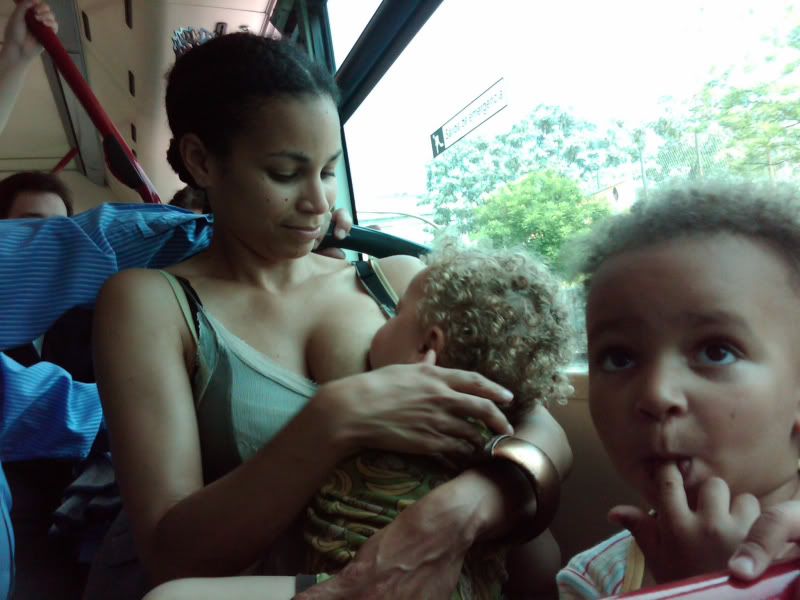
To demonstrate what an avid outdoor nurser I was, check me out on the city bus:


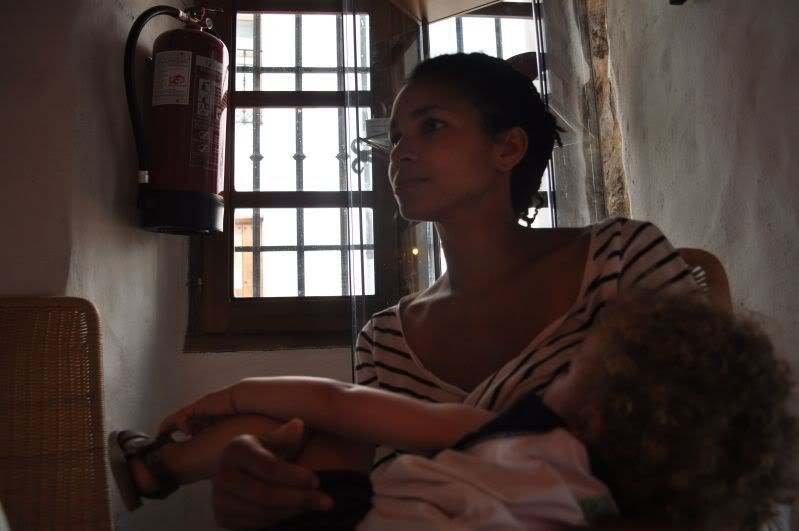
And, at dinner:


I don’t think I look like that much of a weirdo or even, at second glance, that much of a revolutionary.

End of a nursing era…

Nursing was non-negotiable, a decision I am so proud of making. Also non-negotiable, my end date. By the time my son turned two, I’d been regretting that decision for two months.

Perhaps regret is not the right word to use. It felt right to stop nursing. At twenty months, I was getting fatigued. We’re a co-sleeping family and the nighttime nursing was becoming a serious issue. His teeth, too, were a problem. Those early physical pangs started coming back, which I took as my body’s way of telling me it was time to put the boobs back in the holster. Honestly, I wanted my body back, too. Over the course of a few weeks, our nursing came to an end.

Guess what? I was floored by how sad that made me. The warning I had received so long ago in that tower in midtown Manhattan from one of the toughest women I’ve ever met came back and punched me in the gut.

My son and I had forged an unassailable bond through nursing. It’s how we got to know each other. How I conveyed to him for the first time that, as his mommy, “I will never give up on you, even if it makes me bleed.”

That, however, is a lesson he might not fully comprehend until he becomes a parent himself. Just as I didn’t comprehend how much love my parents have for me until I became a mother. That’s a subtlety that’s revealed itself over time, though. In my brief narrative as a parent I have received three big, concrete lessons, weaning being the most bittersweet of all.


The first one I learned from my C-Section: acknowledging my mortality. The second from nursing: mother boldly and fearlessly. And the third: trusting when it’s time to let go.

I sometimes check in with my son to see what he remembers about nursing. For instance, when he wanted to nurse, he would pat my breasts three times and tug at my clothes. Now, when we joke, he pats my breasts three times and dissolves into a cloud of laughter. He remembers…he knows. It’s unassailable, that bond.


Díga(Mama), a.k.a. K. Emily Bond, has worked for lots of newspapers, magazines and online media gigs including O, The Oprah Magazine, Ladies’ Home Journal, The Village Voice, The Daily Beast, iVillage and more. She's now a WAHM living la vida social y real from her little corner in España.

Never want to miss an update of the Blacktating Blog? Subscribe here. Follow me on Twitter- http://www.twitter.com/blacktating

Tuesday, February 1, 2011

Baby Friendly Hospitals Will Improve Black Breastfeeding Rates


A new update on California's breastfeeding rates and hospital policies was released by the California WIC Association and the UC Davis Human Lactation Center. The report, titled "One Hospital at a Time: Overcoming Barriers to Breastfeeding" takes a look at how instituting baby-friendly practices at hospitals through California has impacted the breastfeeding rates.

California is currently home to 34 of the 150 hospitals and birth centers that have been certified as Baby Friendly by UNICEF/WHO. The report paints a very clear picture of how beneficial the Baby Friendly initiative has been to California's breastfeeding rates. Not surprisingly, the hospitals with the lowest breastfeeding rates are those that serve low income women of color and throughout the state, disparities are evident. The report states that in the past, these disparities were chalked up to differences in cultural practices, but the data clearly shows that hospitals that have baby-friendly policies in place were able to greatly reduce those disparities.

The report shows that the breastfeeding initiation rate throughout California for African-American women was at about 78% while the exclusive breastfeeding rate was around 40%. When you look at the exclusive breastfeeding rate for African-American women at the Baby Friendly hospitals, that number jumps from 40% to 60%. And although those numbers are still too low, they are far and away better than the national initiation rate of 54%.

We can also see the benefit of the Baby Friendly Hospital Initiative to African-American women in another state, New York. In New York City, all public hospitals are managed by Health and Hospital Corp., or HHC. HHC has encouraged its hospitals to incorporate all of the Ten Steps to Successful Breastfeeding, but only one, Harlem Hospital, has been certified as Baby Friendly.

Harlem Hospital serves a large population of African-American and African immigrant women. Any hospital that thinks becoming certified would be too difficult or wouldn't work with their population, need only look at Harlem Hospital as proof that it can be done anywhere. In 2007, right before officially becoming Baby-Friendly, 81% of women were breastfeeding when they left Harlem Hospital.

In a recent article in Heart & Soul magazine, a black woman who gave birth at Harlem Hospital talked about her experience. Alicia Lewis-Howard was told by family and friends that breastfeeding would hurt and she didn't think she would nurse for more than a month, but ended up breastfeeding for 6. She credits the nurses at the hospital with showing her how to properly latch the baby on so breastfeeding was not painful and for educating her on the many benefits of breastfeeding both to herself and her baby.

The Baby Friendly Initiative has been proven to increase black breastfeeding initiation and exclusivity rates. It is imperative that healthcare facilities that serve a large population of African-American women begin implementing as many of the Ten Steps as possible. Although the process of becoming Baby Friendly is extremely rigorous, there is no reason that hospitals can't make the smaller changes, like ensuring that all women are breastfeeding within an hour of birth and rooming in with their babies. If we want to see black breastfeeding rates improve, we have to see hospital practices improve. If California and New York can do it, why can't everyone else?


*Photo credit edenpictures


Never want to miss an update of the Blacktating Blog? Subscribe here. Follow me on Twitter- http://www.twitter.com/blacktating

Monday, November 22, 2010

Three Generations of Breastfeeding

Welcome to November's Carnival of Breastfeeding! This month we're all writing about the history of breastfeeding in our families. Please be sure to click through to the other posts linked to at the end of mine.


I was raised by my mother as a single mom with help from her mother and aunt. I know very little about my father's side of the family and that includes any breastfeeding history. I can assume that as the descendant of Africans brought to South Carolina during the slave trade that there is probably a rich history of breastfeeding and some very interesting information to be shared. Unfortunately I don't know any of it, but I do think the history on my mother's side is as fascinating.

My maternal grandmother was born and raised in Lithuania. She and my grandfather (who I am named after) were Holocaust survivors, and my aunt was born shortly after the camps were liberated and the war was over, in West Germany. My grandmother breastfed my aunt until about age two, which would have been very typical for Jews at that time and place. My grandmother also probably had very little choice in this matter. My guess is that infant formula probably wasn't available there, and if it was, it would've been too expensive. The only options available to a woman who was unable to breastfeed were either to mix your own concoction of cow's milk and Karo syrup or hope there was another woman around to cross-nurse your baby. Thankfully my grandmother had plenty of milk. In fact, she used to hand express milk for a neighbor who was unable to breastfeed. She would express milk every day and bring it in to the woman to feed to her baby in glass jars. My mother isn't sure how long this arrangement went on, but her guess is that it was for at least 6 months, at which time solid food could have been safely introduced to the baby.

My mother is first generation born in America in my family. When my grandparents and aunt made the trek to America in the 50s, like many Jewish immigrants they ended up in New York, where my mother was born. In the hospital they were able to convince my grandmother that Similac infant formula was better than breastmilk and so she decided to bottle feed my mother. It seems strange in some ways that a new immigrant family would be willing to spend so much money on a product they could barely afford when breastmilk was available for free, but it was a different time, when modern medicine was saving and improving lives, medicine and doctors had become gods, and it was easier to believe that science could produce something better than nature.


When my mother became pregnant with me in the late 70s, she knew she was going to breastfeed from the start. She was reading books and going to Lamaze and wanted a natural birth. She was a hippie so none of this is surprising to me. My mom says she just instinctually knew that the milk her body would made had to be better than cow's milk for her baby. After a fairly quick and easy birth, she nursed me immediately. I was surprised to learn that in those days there was no rooming in at the hospital, so I was brought to her every 4 hours or so, around-the-clock so she could nurse me. This seems like just barely enough to create an adequate milk supply, but my mom says I was greedy and latched on and nursed like a champ. Because I was jaundiced we stayed in the hospital for 5 days. There were no lactation consultants and the nurses had zero knowledge of breastfeeding and no help, information or support was offered. No wonder only about 30% of women were breastfeeding!

Although my mom suffered from some sore nipples, she said after a few weeks everything seemed to have worked itself out and she never had any problems with supply. She says my father had no opinion on whether or not she breastfed but my grandmother thought she was crazy and backwards for wanting to breastfeed. She said bottle-feeding was easier, but my mom said she thought the idea of having to sterilize bottles and nipples, buy milk and mix and prepare it sounded like a lot more work so she continued to nurse. She did get strange looks and cause folks to whisper and point when she nursed in public, even with a blanket. She said it was a very bold thing to do in those days and something people were definitely not accustomed to seeing. She decided to wean me when I was about 18 months because she had returned to school and was working part-time and it became too much work. She weaned me by telling me there was no milk left and I never asked again and she was amazed at how easy it was to stop. By that point, friends and neighbors had been expressing their disgust for months that she was still breastfeeding me, but she said that didn't factor into her decision, she just had a lot on her plate and breastfeeding had become more of a chore.

Interestingly enough, I remember thinking that everyone always seemed very positive about the fact that my mother nursed me into toddlerhood. For me, it was always a source of pride. In fact, when I had my son, my goal was to "beat" my mom's record and nurse him until at least the age of two. Growing up I had heard so many wonderful stories about breastfeeding that I always thought it was normal and natural, even though I never really saw it around me. There was never a doubt in my mind that I would breastfeed.

I am curious about what breastfeeding will be like in 30 years or so when my generation's kids are having kids. My son is being raised in a bottle-feeding culture and has told me before that babies drink "baby milk" from bottles and that "milkies" are for big boys. When he hears a baby cry in the store he will say, "Mommy, he needs a bottle!" He is in daycare and it's what he sees. I'm hopeful that he will have some memories of our nursing relationship and will remember me breastfeeding any subsequent children we may have. I hope that breastfeeding will be the norm if and when he decides to have children and that he will be supportive of his partner if she decides to do it. It's difficult to think of him having a child and that child not being breastfed but of course that is out of my hands. I do know that my children will grow up knowing about the legacy of breastfeeding in our family and my hope is that it continues on for many generations to come.


Check out the other fantastic posts from this month's Carnival participants.


Christine @ Christine's Contemplations: Carnival of Breastfeeding- My Family History of Nursing 
Judy @ Mommy News Blog: My Family History of Breastfeeding
Jona @ Breastfeeding Twins: Beer & Bottles (and other motherly advice)
Jake Aryeh Marcus: Breastfeeding? Not in My Family
Mama Mo @ Attached at the Nip: How Women in My Family Feed Babies
Alicia @ Lactation Narration: Only the Hippies Were Breastfeeding
Dr. Sarah: Breastfeeding, Circa 1950s
Motherwear Breastfeeding Blog: An Unbroken Chain


Never want to miss an update of the Blacktating Blog? Subscribe here. Follow me on Twitter- I'm @Blacktating

Friday, October 29, 2010

The Landscape of Breastfeeding Support

I'm not sure how I missed this one, but I just stumbled upon the fact that the Centers for Disease Control contracted the United States Breastfeeding Committee to create a library of images of how communities across the country support breastfeeding.

The project is titled "The Landscape of Breastfeeding Support,"and called for breastfeeding coalitions to submit proposals illustrating how they are supporting breastfeeding in their community. Only eight states were selected for inclusion, with my state of Florida choosing to focus on how businesses support their employees who are nursing moms. The Florida Breastfeeding Coalition's photo campaign is called "Get Pumped" and features women who are pumping at work.

The Indiana Black Breastfeeding Coalition was also chosen and their local news covered the story and included some of the fantastic photos they took for the archive. You can see a clip from the news story here.


The projects all had to be completed by the end of September so I'm guessing (hoping!) we'll get a glimpse of the full collection soon. I also hope there will be a lot of diversity in this campaign and that moms from all races, ethnicities and walks of life will be represented. The images will be part of the national archive and I'm guessing available for use in breastfeeding promotion by WIC, authors of breastfeeding books, La Leche League and bloggers alike.

Had you heard about this project? And are you as excited about it as I am?

Never want to miss an update of the Blacktating Blog? Subscribe here. Follow me on Twitter- I'm @Blacktating

Thursday, October 28, 2010

Little Known Black History Fact: The Fultz Quads

During the opening plenary at the Black Mother's Breastfeeding Association's third annual conference, I learned about the Fultz Quads, quadruplet girls born to a tenant farmer named Pete and his deaf, mute wife Annie Mae on May 23, 1946. I'm not sure how I'd never learned about this important piece of African-American history, but I'm happy to be able to share it with you, in case you've never heard of them either.

You can imagine the chances of a couple conceiving quadruplets in the 40s, decades before the availability of fertility treatments, and the fact that the family was poor and black made this a sensational story that garnered nation-wide media attention. The Fultz's already had six children at home when Annie Mae headed to the hospital to give birth to her babies.

The white doctor who delivered the quads, Fred Klenner, gained world renown for attending the birth of the first recorded set of black quadruplets. Dr. Klenner decided to name the girls himself, calling them Mary Ann, Mary Louise, Mary Alice and Mary Catherine. All of the names were for women in his family. The black delivery nurse was quoted in a newspaper article as saying, "At that time, you know, it was before integration. They did us how they wanted. And these were very poor people. He was a sharecropper, Pete was, and she couldn't read or write."

As much of a media circus as the girls' birth was, it seems no one wanted in on the action more than the infant formula companies, whose business was exploding due to the post-war baby boom. In addition to making the girls guinea pigs for his "Vitamin C therapy," Dr. Klenner also negotiated a deal with the PET milk company, which agreed to provide the girls with formula, food, medical care, a private nurse and a farm when they reached adulthood, in exchange for using their image in promotional materials.

This is the beginning of the aggressive marketing of infant formula to African-Americans in this country. Surely the wife of a poor sharecropper would have breastfed her children had PET not come into the picture. And of course black women were breastfeeding their children at this time because they really had no choice. Formula would not have been an affordable or viable option for most people. So although white women were turning to formula in droves, the formula companies were missing a huge portion of the market because black women were still breastfeeding. So how do you change their minds? The image of four beautiful black baby girls "growing up strong" on formula was probably pretty convincing.


The images of the girls as they grew up could be found in ads in black interest publications like Ebony. They even made the cover when they turned one.


They got to meet Presidents Harry Truman, John Kennedy and Althea Gibson, appeared on television shows, and in hundreds of ads for PET milk.


You probably won't be surprised to find out that things didn't work out so well for the Fultz Quads. They were eventually adopted by the baby nurse provided to the family by PET. The farm they were promised turned out to be in the middle of nowhere on land that couldn't grow weeds. They grew up embittered over the way PET profited from their image while they remained poor. The public eventually forgot about them and they lived quiet lives.

But what were the consequences of being fed "baby milk" in infancy? Well, the three eldest of the Fultz quads were all dead of breast cancer before they reached age 55. The youngest sister, Mary Catherine, also has breast cancer. I'll let you draw your own conclusions.

Never want to miss an update of the Blacktating Blog? Subscribe here. Follow me on Twitter- I'm @Blacktating

Tuesday, May 11, 2010

Choosing the new cover for the Easy Guide to Breastfeeding

Did you know that the US Department of Health & Human Services' Office on Women's Health  produces a breastfeeding guide for new mothers? It is called the Easy Guide to Breastfeeding and it explains the benefits of breastfeeding and provides answers to some of the most frequently asked questions about nursing a baby. The publication will be updated soon and they are asking us to help them choose some new cover art. Here are the three choices.


It's hard to tell if this is one mom and one baby posed three different ways, but I don't think it is. I think it's at least two separate women. Either way, the options are limited to three separate images of a white mother and her white baby. Not even a little bit of diversity, Office on Women's Health? This is the edition of the guide that is labeled as for "all women." But all women are not white and there are plenty of women of other races and ethnicities who breastfeed. Why couldn't any of us be represented here?

OK, I know that the Office of Women's Health produces special editions of the guide aimed at African-American, Native American and Hispanic moms. Goodness knows I understand that there are issues specific to various communities that keep moms from breastfeeding and that it's important for those to be addressed. The editions for minority moms are getting a make-over, too. But why is that the edition that is supposed to be for all women can only feature a white woman on the cover?Is the thinking that white women won't understand this guide is for them too if there is a woman of color on the cover? If so, then why are women of color expected to be fine with only choosing from 3 white women? I guess we're supposed to be used to the fact that the default or the norm is white and if we want anything culturally sensitive or balanced, we must find the separate book with the woman of color on the cover?

 I have no idea if they are planning on having this same voting for the special editions, but even so I think this was a huge misstep, and one that hopefully will not be repeated when they update again. So what do you think, ladies? Do you find this to be as much of an EPIC FAIL on their part as I do? What would have been a smarter move?  A contest, but with at least one woman of color as an option? A cover with multiple ethnicities represented?

Never want to miss an update of the Blacktating Blog? Subscribe here. Twitter me- I'm blacktating

Thursday, March 25, 2010

Do attitudes about formula explain breastfeeding disparity?

A new research study conducted at Cincinnati Children's Hospital Medical Center has found that black mothers' attitudes about formula may explain disparate breastfeeding rates. According to the study, moms of all races (Black, White, Hispanic and Asian) are equally comfortable with the idea of breastfeeding. In fact, 60% of black moms initiated breastfeeding in the hospital in 2006, compared with 77% of white moms. The difference was that black moms were much more comfortable with the idea of formula feeding than the moms of other races.

I'm not really surprised about the findings in this study (the article I read didn't say how many women were polled or what their socioeconomic status is) because I have found many moms who think formula is just as good as breast milk or a very close second. I also think we have to remember that most black moms are planning on returning to work after they have a baby and many will not have support in the workplace to pump (Isotoner anyone?) If you know you're going back to work and you know you may not be able to breastfeed past 12 weeks, you're going to have to believe that formula is fine or else you're going to drive yourself crazy thinking you are harming your baby.

The lead author of the study, Dr. Laurie Nommsen-Rivers, says the study raises an interesting point about how breastfeeding should be promoted. “The study results tell us that public health campaigns to promote breastfeeding must also include messages regarding the risks of formula feeding. We are committed to learning more about what influences women’s understanding of the risks of formula feeding, because this is a key part of improving breastfeeding practices and therefore, infant health, for some of our most vulnerable newborns,” she said.

So black moms, what do you think? Are your friends and family members comfortable with the idea of formula feeding? Do you feel they understand the risks to themselves and their babies that choosing not to breastfeed poses? Is it even a question of getting black moms to understand the risks of formula? I'd love to hear your thoughts in the comments.

Related Posts with Thumbnails