
 Posts
Posts


Although the city of Milwaukee has been villified (and rightly so) for their anti-bedsharing campaign that used images of babies in bed with dangerous items like butcher knives, I have to give props to this breastfeeding video put together by the city's newspaper.
Featuring the awesome Dalvery Blackwell, co-founder of the African-American Breastfeeding Network, this video highlights a program in Milkwaukee aimed at encouraging young African-American moms to initiate breastfeeding.
The video was put together as part of the Journal Sentinel Online's Empty Cradles feature, which covers the city's abysmal infant mortality rates. It's a huge problem for the city that has definitely reached epidemic proportions. From unsafe sleep sleep deaths and lack of breastfeeding to social problems like alcoholism and smoking, black babies in Milwaukee are definitely at an increased risk for death in the first year of life.
Hats off to Dalvery and the great work she is doing. I'm glad she is being recognized as she fights the good fight.
To watch the video, click here.
Never want to miss an update of the Blacktating Blog? Subscribe here. Follow me on Twitter- http://www.twitter.com/blacktating 
Monday, February 27, 2012
Breastfeeding Makes Strong Babies


Friday, January 27, 2012
Louisville Black Breastfeeding PSAs
The city of Louisville, KY has created four new breastfeeding PSA as part of its Mayor's Healthy Hometown Movement "Good for your body, great for EVERYbody" campaign. The aim is to make Louisville one of the healthiest cities in the country, a lofty goal. The PSAs focus on one family and show the benefits of breastfeeding for mom and baby, and how dads and grandmas can support mom to make breastfeeding successful. You can check out all of the videos below.
It looks like they took a page out of the etrade baby commercials playbook to create the ads. I like that the city understands the importance of breastfeeding in creating a healthier community. I'm sure some people may criticize them for showing bottlefeeding in the "Big Momma" and "Dad" breastfeeding videos, and encouraging moms to use covers when nursing in public, but I think the reality is that most moms do return to work and use bottles and many moms don't feel comfortable breastfeeding in public without some sort of cover up. And no matter how many times breastfeeding advocates say it's not true, most people still think dads and grandmas need to give the baby a bottle in order to bond with her. Many people still believe breastfeeding in public is nasty, with or without a cover, so I like the message that it's perfectly natural. Since we know how important support is from partners and mothers, particularly in the black community, I think the ads work well. I like the promotion of breastfeeding as a family affair, because moms really do need to be encouraged and supported by loved ones if they are going to breastfeed successfully. So what do you think of these ads? Thumbs up or down?
*Hat tip to The Motherwear Breastfeeding Blog for the heads up about these videos
Never want to miss an update of the Blacktating Blog? Subscribe here. Follow me on Twitter- http://www.twitter.com/blacktating
Wednesday, January 18, 2012
Is Beyonce Breastfeeding?
On the red carpet at the recent BET Honors show in DC, Beyonce's former Destiny's Child bandmate Michelle was interviewed and of course she was asked about baby Blue.
“We’ve been doing everything, whatever [Beyonce] needs," said Williams. Though there is one thing the ladies can’t help their superstar friend with. “No breastfeeding,” joked Williams. “Ain’t no milk coming out.”
Beyonce breastfeeding? It sounds like she is! Here's hoping she confirms soon, as it will be the culmination of every black lactivist's wet dreams.
Never want to miss an update of the Blacktating Blog? Subscribe here.
Follow me on Twitter- I'm @Blacktating
Wednesday, October 5, 2011
Tamera Mowry Drinks Sister Tia's Breastmilk
Have you been watching the new reality show, Tia & Tamera, that follows twin sisters Tia and Tamera Mowry? In the series, Tia is expecting her first child, while Tamera is planning her wedding. Throughout the season we've seen Tia planning for the birth of her baby by interviewing a doula, considering a home birth and talking about breastfeeding. Unfortunately a breech baby necessitated a hospital birth and a C-section for Tia, which was documented in the series finale which aired recently. We get to see the birth of baby Cree, as well as their early days at home.
At one point, Tia, who is pumping for the baby, highly encourages her sister Tamera to taste her milk.
What do you think, would you taste your sister's milk? I don't have a sister and although I did taste my own milk, I am not sure I'd taste someone else's.
Never want to miss an update of the Blacktating Blog? Subscribe here. Follow me on Twitter- I'm @Blacktating
Thursday, April 14, 2011
Guest Post: Our Unassailable Bond
I'm pleased to present a guest post today from K. Emily Bond, Writer, Editor, Researcher and Blogger Extraordinaire!
Through blood and tears, breastfeeding fortified our unassailable bond
Once upon a time, pre-baby when my life was one big ball of crime writing ambition, I had a literary agent who told me, “I was not someone who had to have a kid, you know what I mean?”
I can’t resist the impulse to fact-check. The preceding was an estimation of what she said to me in my heavily pregnant state—and I don’t need to remind you how reliable our memories are 40 weeks into gestation.
Basically she was conveying that “maternal” was not a state that came naturally to her. Breastfeeding on the other hand, the most primal of maternal acts, caught her by surprise. This, I remember her saying pretty accurately: “The thing I miss most is nursing.”
I didn’t get it at the time. Her kid was a teenager whose best friend’s dad was a famous rock star. Clearly, a lot had transpired since she weaned: first steps, first words…first VIP passes to the MTV Music Video Awards. How could nursing be the thing she reflected on or even missed the most?
Now, six months after my son and I have weaned, I’m starting to get it.
In the beginning…
For me, nursing was an exceedingly difficult physical challenge. I had a C-section, for starters, and at one point during the birth had been put on antibiotics. As such, my body and son’s mouth became a Petri dish for sharing candida: the dreaded oral thrush. Ouch.
For weeks, I endured bleeding, cracked nipples, piercing razor-like pain that shot through my breasts like daggers each and every time my son latched on. Taking a shower was an event I dreaded because I knew at some point water would have to come in contact with my tender nipples. And, truth be told, every time my little bundle of discomfort—sorry, joy—wanted to nurse, I’d cringe: “Oh, no…not again!”
Those initial months…well, they sucked. And, oy vey, could that boy suck—with the ferocity of a Hoover, or a character out of Twilight.
Come hell or high water, though—or in this case, cracked nipples or bleeding—I made a commitment to my son and to myself to keep on nursing. And we did, boobs in tact.
What saved our nursing relationship in the end was La Leche League International, Nystatin, dietary changes (more leafy greens and yogurt; less refined sugars and carbohydrates) and these:

A nursing revolution…
Nip slips never bothered me. It didn’t matter where I was or how shocking it might have looked in an Ikea aisle, house of worship, pancake house or shopping mall. If it was time to nurse, the boobs came out. I got the occasional comment, sure. But nursing was too precious of a bond to be cut short by a guy who said stupid things like, “You need to give that baby a biscuit,” with his pregnant wife in tow.
My attitude was, “if you don’t like it… stop looking.” Perv.
In retrospect, I did perhaps take some perverse pleasure in shocking dudes like that. I felt like a revolutionary demonstrating to the world how natural it is to integrate nursing into your daily life. It was a bit, “look at me – I can nurse and shop for groceries at the same time!” but it was true…with a good baby carrier, anything is possible.
To demonstrate what an avid outdoor nurser I was, check me out on the city bus:
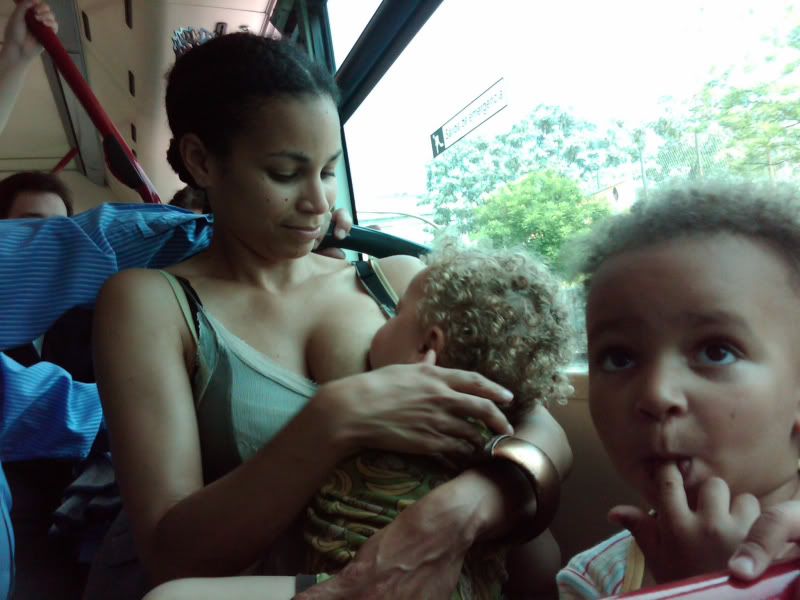
And, at dinner:
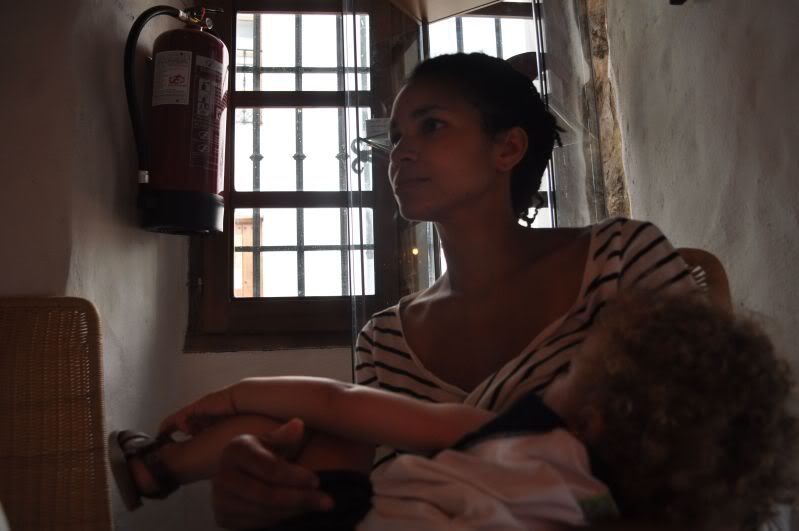
I don’t think I look like that much of a weirdo or even, at second glance, that much of a revolutionary.
End of a nursing era…
Nursing was non-negotiable, a decision I am so proud of making. Also non-negotiable, my end date. By the time my son turned two, I’d been regretting that decision for two months.
Perhaps regret is not the right word to use. It felt right to stop nursing. At twenty months, I was getting fatigued. We’re a co-sleeping family and the nighttime nursing was becoming a serious issue. His teeth, too, were a problem. Those early physical pangs started coming back, which I took as my body’s way of telling me it was time to put the boobs back in the holster. Honestly, I wanted my body back, too. Over the course of a few weeks, our nursing came to an end.
Guess what? I was floored by how sad that made me. The warning I had received so long ago in that tower in midtown Manhattan from one of the toughest women I’ve ever met came back and punched me in the gut.
My son and I had forged an unassailable bond through nursing. It’s how we got to know each other. How I conveyed to him for the first time that, as his mommy, “I will never give up on you, even if it makes me bleed.”
That, however, is a lesson he might not fully comprehend until he becomes a parent himself. Just as I didn’t comprehend how much love my parents have for me until I became a mother. That’s a subtlety that’s revealed itself over time, though. In my brief narrative as a parent I have received three big, concrete lessons, weaning being the most bittersweet of all.
The first one I learned from my C-Section: acknowledging my mortality. The second from nursing: mother boldly and fearlessly. And the third: trusting when it’s time to let go.
I sometimes check in with my son to see what he remembers about nursing. For instance, when he wanted to nurse, he would pat my breasts three times and tug at my clothes. Now, when we joke, he pats my breasts three times and dissolves into a cloud of laughter. He remembers…he knows. It’s unassailable, that bond.
Díga(Mama), a.k.a. K. Emily Bond, has worked for lots of newspapers, magazines and online media gigs including O, The Oprah Magazine, Ladies’ Home Journal, The Village Voice, The Daily Beast, iVillage and more. She's now a WAHM living la vida social y real from her little corner in España.

Never want to miss an update of the Blacktating Blog? Subscribe here. Follow me on Twitter- http://www.twitter.com/blacktating
Wednesday, February 23, 2011
Seeking Submissions for the March Carnival of Breastfeeding: On Breastfeeding & Race

The theme for the March Carnival of Breastfeeding is breastfeeding and race. This month, we'd especially love to hear from moms of color about your breastfeeding experience and what role you think your race played in shaping that experience. Some topics that we'd love to hear you explore are:
- What are the cultural beliefs about breastfeeding amongst your race?
- Do you think your race played a role in how you were treated by health care providers, including nurses, lactation consultants, OBGYN and pediatrician?
- What are the breastfeeding rates like for people of your race, and how did this influence your decision to breastfeed?
- Any other observations about what breastfeeding is like in your community?
- Well-written and free of grammatical errors
- Directly on topic for the Carnival theme
- Submitted by blogs that cover topics that are of interest to our readers (breastfeeding, parenting, etc).
Never want to miss an update of the Blacktating Blog? Subscribe here. Follow me on Twitter- http://www.twitter.com/blacktating
Tuesday, February 1, 2011
Baby Friendly Hospitals Will Improve Black Breastfeeding Rates

California is currently home to 34 of the 150 hospitals and birth centers that have been certified as Baby Friendly by UNICEF/WHO. The report paints a very clear picture of how beneficial the Baby Friendly initiative has been to California's breastfeeding rates. Not surprisingly, the hospitals with the lowest breastfeeding rates are those that serve low income women of color and throughout the state, disparities are evident. The report states that in the past, these disparities were chalked up to differences in cultural practices, but the data clearly shows that hospitals that have baby-friendly policies in place were able to greatly reduce those disparities.
The report shows that the breastfeeding initiation rate throughout California for African-American women was at about 78% while the exclusive breastfeeding rate was around 40%. When you look at the exclusive breastfeeding rate for African-American women at the Baby Friendly hospitals, that number jumps from 40% to 60%. And although those numbers are still too low, they are far and away better than the national initiation rate of 54%.
We can also see the benefit of the Baby Friendly Hospital Initiative to African-American women in another state, New York. In New York City, all public hospitals are managed by Health and Hospital Corp., or HHC. HHC has encouraged its hospitals to incorporate all of the Ten Steps to Successful Breastfeeding, but only one, Harlem Hospital, has been certified as Baby Friendly.
Harlem Hospital serves a large population of African-American and African immigrant women. Any hospital that thinks becoming certified would be too difficult or wouldn't work with their population, need only look at Harlem Hospital as proof that it can be done anywhere. In 2007, right before officially becoming Baby-Friendly, 81% of women were breastfeeding when they left Harlem Hospital.
In a recent article in Heart & Soul magazine, a black woman who gave birth at Harlem Hospital talked about her experience. Alicia Lewis-Howard was told by family and friends that breastfeeding would hurt and she didn't think she would nurse for more than a month, but ended up breastfeeding for 6. She credits the nurses at the hospital with showing her how to properly latch the baby on so breastfeeding was not painful and for educating her on the many benefits of breastfeeding both to herself and her baby.
The Baby Friendly Initiative has been proven to increase black breastfeeding initiation and exclusivity rates. It is imperative that healthcare facilities that serve a large population of African-American women begin implementing as many of the Ten Steps as possible. Although the process of becoming Baby Friendly is extremely rigorous, there is no reason that hospitals can't make the smaller changes, like ensuring that all women are breastfeeding within an hour of birth and rooming in with their babies. If we want to see black breastfeeding rates improve, we have to see hospital practices improve. If California and New York can do it, why can't everyone else?
*Photo credit edenpictures
Never want to miss an update of the Blacktating Blog? Subscribe here. Follow me on Twitter- http://www.twitter.com/blacktating
Monday, November 22, 2010
Three Generations of Breastfeeding
Welcome to November's Carnival of Breastfeeding! This month we're all writing about the history of breastfeeding in our families. Please be sure to click through to the other posts linked to at the end of mine.
I was raised by my mother as a single mom with help from her mother and aunt. I know very little about my father's side of the family and that includes any breastfeeding history. I can assume that as the descendant of Africans brought to South Carolina during the slave trade that there is probably a rich history of breastfeeding and some very interesting information to be shared. Unfortunately I don't know any of it, but I do think the history on my mother's side is as fascinating.
My maternal grandmother was born and raised in Lithuania. She and my grandfather (who I am named after) were Holocaust survivors, and my aunt was born shortly after the camps were liberated and the war was over, in West Germany. My grandmother breastfed my aunt until about age two, which would have been very typical for Jews at that time and place. My grandmother also probably had very little choice in this matter. My guess is that infant formula probably wasn't available there, and if it was, it would've been too expensive. The only options available to a woman who was unable to breastfeed were either to mix your own concoction of cow's milk and Karo syrup or hope there was another woman around to cross-nurse your baby. Thankfully my grandmother had plenty of milk. In fact, she used to hand express milk for a neighbor who was unable to breastfeed. She would express milk every day and bring it in to the woman to feed to her baby in glass jars. My mother isn't sure how long this arrangement went on, but her guess is that it was for at least 6 months, at which time solid food could have been safely introduced to the baby.
My mother is first generation born in America in my family. When my grandparents and aunt made the trek to America in the 50s, like many Jewish immigrants they ended up in New York, where my mother was born. In the hospital they were able to convince my grandmother that Similac infant formula was better than breastmilk and so she decided to bottle feed my mother. It seems strange in some ways that a new immigrant family would be willing to spend so much money on a product they could barely afford when breastmilk was available for free, but it was a different time, when modern medicine was saving and improving lives, medicine and doctors had become gods, and it was easier to believe that science could produce something better than nature.

When my mother became pregnant with me in the late 70s, she knew she was going to breastfeed from the start. She was reading books and going to Lamaze and wanted a natural birth. She was a hippie so none of this is surprising to me. My mom says she just instinctually knew that the milk her body would made had to be better than cow's milk for her baby. After a fairly quick and easy birth, she nursed me immediately. I was surprised to learn that in those days there was no rooming in at the hospital, so I was brought to her every 4 hours or so, around-the-clock so she could nurse me. This seems like just barely enough to create an adequate milk supply, but my mom says I was greedy and latched on and nursed like a champ. Because I was jaundiced we stayed in the hospital for 5 days. There were no lactation consultants and the nurses had zero knowledge of breastfeeding and no help, information or support was offered. No wonder only about 30% of women were breastfeeding!
Although my mom suffered from some sore nipples, she said after a few weeks everything seemed to have worked itself out and she never had any problems with supply. She says my father had no opinion on whether or not she breastfed but my grandmother thought she was crazy and backwards for wanting to breastfeed. She said bottle-feeding was easier, but my mom said she thought the idea of having to sterilize bottles and nipples, buy milk and mix and prepare it sounded like a lot more work so she continued to nurse. She did get strange looks and cause folks to whisper and point when she nursed in public, even with a blanket. She said it was a very bold thing to do in those days and something people were definitely not accustomed to seeing. She decided to wean me when I was about 18 months because she had returned to school and was working part-time and it became too much work. She weaned me by telling me there was no milk left and I never asked again and she was amazed at how easy it was to stop. By that point, friends and neighbors had been expressing their disgust for months that she was still breastfeeding me, but she said that didn't factor into her decision, she just had a lot on her plate and breastfeeding had become more of a chore.
Interestingly enough, I remember thinking that everyone always seemed very positive about the fact that my mother nursed me into toddlerhood. For me, it was always a source of pride. In fact, when I had my son, my goal was to "beat" my mom's record and nurse him until at least the age of two. Growing up I had heard so many wonderful stories about breastfeeding that I always thought it was normal and natural, even though I never really saw it around me. There was never a doubt in my mind that I would breastfeed.
I am curious about what breastfeeding will be like in 30 years or so when my generation's kids are having kids. My son is being raised in a bottle-feeding culture and has told me before that babies drink "baby milk" from bottles and that "milkies" are for big boys. When he hears a baby cry in the store he will say, "Mommy, he needs a bottle!" He is in daycare and it's what he sees. I'm hopeful that he will have some memories of our nursing relationship and will remember me breastfeeding any subsequent children we may have. I hope that breastfeeding will be the norm if and when he decides to have children and that he will be supportive of his partner if she decides to do it. It's difficult to think of him having a child and that child not being breastfed but of course that is out of my hands. I do know that my children will grow up knowing about the legacy of breastfeeding in our family and my hope is that it continues on for many generations to come.
Check out the other fantastic posts from this month's Carnival participants.
Never want to miss an update of the Blacktating Blog? Subscribe here. Follow me on Twitter- I'm @Blacktating
Monday, November 1, 2010
Black Mothers Breastfeeding Association Conference

On October 25th, I had the pleasure of speaking at the Third Annual Black Mothers' Breastfeeding Association conference. BMBFA has been on my radar for a few years now, and I've written before about how I think the founder, Kiddada Ramey, is one of the top black movers and shakers in the breastfeeding world.
Now, when Kiddada asked me to speak I was scared out of my mind. I speak all the time in front of groups for my real job, but I've never done a presentation for a breastfeeding conference. I knew that lots of amazing women were going to be presenting (including Bettina Forbes of Best for Babes, Napiera Loveless of MamaTotoMatema and researcher Dr. Paula Meier) and I didn't want to disappoint anyone. But I figured this was a good place to get my feet wet because it was a smaller, more intimate conference and I would be amongst friends. I already knew that some of the moms from BMBFA that I communicate with on Facebook and Twitter would be there. I just couldn't turn down the opportunity to meet so many wonderful people in person.
I presented on one of my favorite topics: how I use blogging and other forms of social media to connect with other black breastfeeding moms online. I think the presentation went really well. People asked some great questions afterwards and a couple even come up to me afterwards to tell me how much they liked my presentation. It was so nice to get such positive feedback. I was really feeling the love, ya'll!
Kiddada was so inspiring and I really want to be like her when I grow up! I'd love to start a chapter of BMBFA locally or use the power of social media to raise some funds for the organization because she is doing such amazing things for moms in Detroit. I'm already looking forward to going back next year!
*FYI, I've decided to participate in National Blog Post Month AKA NaBloPoMo. The point is to improve your writing skills by blogging every.single.day. throughout the month of November. I'm going to give it a whirl. I can't promise that all of my posts will be good, but you WILL be hearing from me every day for the next 30 days. Hopefully I'll be able to keep it interesting and fresh.
Never want to miss an update of the Blacktating Blog? Subscribe here. Follow me on Twitter- I'm @Blacktating
Friday, October 29, 2010
The Landscape of Breastfeeding Support
I'm not sure how I missed this one, but I just stumbled upon the fact that the Centers for Disease Control contracted the United States Breastfeeding Committee to create a library of images of how communities across the country support breastfeeding.
The project is titled "The Landscape of Breastfeeding Support,"and called for breastfeeding coalitions to submit proposals illustrating how they are supporting breastfeeding in their community. Only eight states were selected for inclusion, with my state of Florida choosing to focus on how businesses support their employees who are nursing moms. The Florida Breastfeeding Coalition's photo campaign is called "Get Pumped" and features women who are pumping at work.
The Indiana Black Breastfeeding Coalition was also chosen and their local news covered the story and included some of the fantastic photos they took for the archive. You can see a clip from the news story here.

The projects all had to be completed by the end of September so I'm guessing (hoping!) we'll get a glimpse of the full collection soon. I also hope there will be a lot of diversity in this campaign and that moms from all races, ethnicities and walks of life will be represented. The images will be part of the national archive and I'm guessing available for use in breastfeeding promotion by WIC, authors of breastfeeding books, La Leche League and bloggers alike.
Had you heard about this project? And are you as excited about it as I am?
Never want to miss an update of the Blacktating Blog? Subscribe here. Follow me on Twitter- I'm @Blacktating
Wednesday, March 31, 2010
NYC Hospitals Aim to Become Baby Friendly
Eleven hospitals in New York City are currently working towards becoming certified “Baby Friendly” by the World Health Organization & UNICEF. The hospitals, which are a part of NYC’s Health & Hospitals Corporation, are also specifically targeting African-American moms who make up one third of their clientele. If these hospitals become Baby Friendly, it will have a huge impact on the number of black women who initiate breastfeeding in the hospital.
According to a recent article on WeNews, the city’s health department is providing funding for public hospitals to launch this initiative and hire a breastfeeding coordinator at each hospital. This is seriously a HUGE deal and a fantastic step towards breaking down one of the biggest barriers to breastfeeding, free formula and swag bags from the hospital. If NYC pulls this off, they have the potential to become the first major metropolitan area to reverse the trend of low breastfeeding rates for black women.
Trish MacEnroe, Director of the Baby Friendly Hospital Initiative in the US, told WeNews, “New York will bust the myth that going Baby Friendly is an impossible task. If you can go Baby Friendly in New York, with different races, languages and cultures, and with hospitals being fiscally challenged, that sends a powerful message to all hospitals that breastfeeding is an achievement you can reach."
There are currently only a paltry 86 hospitals in the entire country that can boast that they are Baby Friendly. Hopefully soon there will be 11 more.
Tuesday, March 30, 2010
Black Breastfeeding: You have to see it to believe it
Today someone asked me if I knew of any public service announcements or campaigns to promote breastfeeding featuring black moms and babies or other women of color. Why, yes, I do, and I pointed her to a recent few of them. It got me thinking about how rarely in my day to day life I see women of color breastfeeding. Of course I hardly see ANY women breastfeeding, but when I do, they are always white. I think that is one of the hurdles we face in trying to get more black women to breastfeed. If you don't see women who look like you doing it, you think this is something that isn't for you.
Thankfully there have been a lot of breastfeeding awareness campaigns that have featured women of color. And although sometimes I am disappointed in the images used in many ad campaigns selling products for breastfeeding moms, lots of companies get it right and use diverse models.
So with this in mind, I decided to create a resource for those of you who work in breastfeeding support or are doulas and childbirth educators that feature pictures of women of color, particularly black women, breastfeeding. I will link to the original source whenever possible and update this post and leave a link to it in my sidebar. If you find any others that you think should be included, please email them to me.
California Department of Public Health- Mother's Milk for Daddy's Baby campaign
California Department of Public Health- Formula. Mother's Milk. Not the Same campagin
Ontario Human Rights Commission- A Baby's Right to Eat

INFACT Canada- Benefits 101 Series
Shelby County, TN- Babies Were Born to be Breastfed
Texas WIC- I'm a proud breastfeeding dad amongst others
Texas WIC- African-American Breastfeeding Promotion
Austin WIC- I breastfeed because....
Companies that use moms of color in their ads


Hygeia
There are a few, but it's not enough! If I am missing a brand you know and love, let me know in the comments and I'll add them to the list. If there is another PSA that you know of, tell me about it so I can spread the word.
Thursday, March 25, 2010
Do attitudes about formula explain breastfeeding disparity?
A new research study conducted at Cincinnati Children's Hospital Medical Center has found that black mothers' attitudes about formula may explain disparate breastfeeding rates. According to the study, moms of all races (Black, White, Hispanic and Asian) are equally comfortable with the idea of breastfeeding. In fact, 60% of black moms initiated breastfeeding in the hospital in 2006, compared with 77% of white moms. The difference was that black moms were much more comfortable with the idea of formula feeding than the moms of other races.
I'm not really surprised about the findings in this study (the article I read didn't say how many women were polled or what their socioeconomic status is) because I have found many moms who think formula is just as good as breast milk or a very close second. I also think we have to remember that most black moms are planning on returning to work after they have a baby and many will not have support in the workplace to pump (Isotoner anyone?) If you know you're going back to work and you know you may not be able to breastfeed past 12 weeks, you're going to have to believe that formula is fine or else you're going to drive yourself crazy thinking you are harming your baby.
The lead author of the study, Dr. Laurie Nommsen-Rivers, says the study raises an interesting point about how breastfeeding should be promoted. “The study results tell us that public health campaigns to promote breastfeeding must also include messages regarding the risks of formula feeding. We are committed to learning more about what influences women’s understanding of the risks of formula feeding, because this is a key part of improving breastfeeding practices and therefore, infant health, for some of our most vulnerable newborns,” she said.
So black moms, what do you think? Are your friends and family members comfortable with the idea of formula feeding? Do you feel they understand the risks to themselves and their babies that choosing not to breastfeed poses? Is it even a question of getting black moms to understand the risks of formula? I'd love to hear your thoughts in the comments.
Wednesday, March 10, 2010
Happy Black Girl Day!
I'm pleased to present a post today in honor of the Happy Black Girl Day 2: Happier and Blacker. HBGD was created by Sista Toldja of The Beautiful Struggler, whom I fell in love with after her post on why black women weren't exactly thrilled with the choice of Reggie Bush as Essence Magazine's "love issue" cover model. But enough about the stuff that pisses us off, Happy Black Girl Day is about celebrating everything that is wonderful about being a black girl.
So today I am celebrating some of my favorite black girls who understand the importance of birth autonomy, breastfeeding and natural parenting. Here are my Top 5.
#1. Phylicia Rashad- Yes, the original black Super Mom is a breastfeeding mom in real life. Not to be outdone by the character she played for years, Phylicia is a phenom who is not only still acting but also recently narrated "Bringin' in da Spirit," a documentary about the history of black midwives in America. She hosted a DVD that provided breastfeeding information for parents-to-be called "Your Healthy Baby." On Mother's Day she appeared on the Al Sharpton radio show to discuss maternal health and stressed the importance of food as medicine and the importance of motherhood.
#2. Lisa Bonet- OK, so she's a little nuts (I mean, Lilakoi Moon? Really?) but she's in a relationship with the super hot Jason Momoa and has ridiculously gorgeous kids. She's also a self-proclaimed "hippie at heart" who gave birth at home and breastfed all her babies.
#3. Deborah Cox- The platinum-selling singer is a mom of three breastfed babies. Deborah says she is "a big believer in breastfeeding" because "at the end of the day, you have healthier kids." So true!
#4. Halle Berry- The most beautiful mom on the planet breastfed her daughter and praised Larrivo nursing bras for making breastfeeding "sexy." She's also a co-sleeping mama: baby Nahla slept in an Arms Reach co-sleeper.
#5. Tonya Lewis-Lee- Spike Lee's wife Tonya is the executive producer of the film "Crisis in the Crib," a documentary about the high infant mortality rate in the black community. She is working with the department of Health & Human Services to promote breastfeeding and was the face of the "A Healthy Baby Begins With You" campaign. Tonya was breastfed herself until she was two and plans on nursing her own daughter just as long.
Want to read the other Happy Black Girl Day posts? Check them out here (will be updated throughout the day).
Never want to miss an update of the Blacktating Blog? Subscribe here.
Twitter me- I'm blacktating
Wednesday, February 10, 2010
Black Women Breastfeeding: A Multigenerational Story
Here is a beautiful video featuring one family's story of breastfeeding.
Never want to miss an update of the Blacktating Blog? Subscribe here.
Twitter me- I'm blacktating
Wednesday, December 23, 2009
Teaching Black Women to Embrace Breastfeeding
NPR seems to be thinking a lot about the topic of this blog, black women and breastfeeding. First there was the piece in November that talked about how black women often avoid breastfeeding. Then today, another piece, also featuring Kathi Barber, about decreasing the disparities in breastfeeding rates. Why do black women breastfeed less than all other races, and how can we narrow that nursing gap?
The piece talks about the negative image that many black women have of breastfeeding, that of the tribal women, with long, sagging breasts that you see in National Geographic. There is also the belief that breastfeeding is painful and gross. In addition, most black women return to work soon after having children and we know how difficult it is to continue to breastfeed while working, particularly when doing blue collar work. Combine that with a lack of breastfeeding role models, the hypersexualization of black bodies, the inability to see breasts as anything but sexual objects, and well, you can see why we have so many problems.
Kathi Barber also sees a link between low breastfeeding rates in the African-American community and the legacy of slavery. Do 21st century moms still carry the anger of the slave forced to breastfeed the master's white children while her own baby starved? Possibly. I think the bigger issue may be the pervasive reluctance to do or be anything deemed as "white." Who are the vocal and visible black women that breastfed? There are a handful of celebrities, but how often do you encounter a black woman breastfeeding while at church or the park or at daycare or a family event?
The thing that leaves me scratching my head, and that I didn't fully realize, was that even middle-class, educated black women have pretty abysmal breastfeeding rates when compared to our white counterparts. Maybe because it seems most of the black women I know who are like me DID breastfeed, at least for a few months if not longer. If the women with the most education, the ones most likely to have a supportive work environment, to truly understand all of the benefits to breastfeeding, aren't doing it, how can we expect anyone else to?
It seems there is still a ton of work to be done and I'm grateful that people like Kathi, who founded the African-American Breastfeeding Alliance, are working hard to promote and protect breastfeeding in the black community.
Never want to miss an update of the Blacktating Blog? Subscribe here.
Twitter me- I'm blacktating

